Last update September 8, 2026 by Alberto Llopis
Last update: 3 September 2026.
El Ajax de 1995 He is not remembered just because he won the Champions League.. It is remembered because it seemed to come from somewhere else.. It was not a team built with a checkbook nor a collection of stars bought to raise a cup.. It was an idea with a white t-shirt and red stripe. A gang of young footballers, shameless, technicians, raised in a ball and blackboard culture, who stood in front of Milan and told European football that it was still possible to win from the quarry.
There are teams that age like a file card. Louis van Gaal's Ajax ages like a VHS tape that you want to play again. Van der Sar under sticks, Danny Blind commanding with serenity, Rijkaard as adult memory, Davids with his lungs on, Seedorf playing with inappropriate maturity, Litmanen finding spaces that no one saw, Overmars breaking outside, Finidi dancing in the band and Kluivert appearing in Vienna with the insolence of teenagers destined not to ask permission.
That Ajax was European champion 24 May 1995, but his legend does not fit in one night. It came from a way of understanding football, of a city, from a school, of a shirt that seemed simple until it started to move. That's why it continues to have so much strength in retro football.: because it represents one of the last times in which a training club conquered Europe without ceasing to look like a training club.
The last young champion before hypermarket football
To understand the nostalgia that Ajax awakens 1995 We must return to a Europe before the permanent market. The Champions League was already transforming, but it was not yet the armored territory of a few economic giants. The youth clubs could still look directly at the Italian empires. Television grew, the brands pressed, the agents gained weight, but there was a gap through which teams with a school soul entered.
Ajax slipped through that crack with tremendous naturalness. I didn't play like an outsider who was happy to be there.. He played as if he had a historical responsibility. In Amsterdam, the word Ajax came loaded with Cruyff, total football, of triangles, open ended, of center backs who knew how to pass and midfielders who never hid. Van Gaal did not copy that inheritance like someone who copies an old photo: turned it into a modern system, disciplined and fierce.
That was the charm. That team had youth, but not naivety. I had joy, but not disorder. I pressed, moved, I expected, accelerated and started again. It was coral, but not anonymous. Each player seemed like a piece of a very precise machine, although at the same time he retained a recognizable personality. El Ajax de 1995 It was tactical., yes, but it was also the smell of an old stadium, to European Wednesday night football and t-shirts that today are sought after as relics.
Louis van Gaal and an idea taken to the limit
Louis van Gaal was the architect of that house. His Ajax did not live on loose inspiration, but of an almost obsessive faith in order. The players knew where to be, when to jump, when to close, when to open the field and when to bite after a loss. That might sound cold explained from a blackboard., but on the grass he had rhythm. It was a choreography with fangs.
Van Gaal did something that seems simple when you tell it thirty years later and very difficult when you try to repeat it.: turned young people into competitive adults without completely taking away their freshness. Clarence Seedorf did not look like a youth. Edgar Davids didn't seem to be afraid of anyone. Kluivert still had the face of a boy, but he already smelled the area like a big striker. Overmars ran as if each band were a newly opened runway. Litmanen, perhaps the finest of all, He moved between the lines with silent elegance.
The coach was not an ornament in that story. It was the framework. And within the frame, the footballers painted one of the most remembered seasons of the years 90.
T-shirt, the quarry and the memory
Ajax always had one of the most recognizable shirts in European football, but in 1995 that garment became a generational symbol. Blanca, roja, clean, almost school. He didn't need too many decorations because the team already had enough identity. View today, retains something that many modern t-shirts have lost: silence. Doesn't scream. It appears and one immediately understands which club is being talked about.
In that t-shirt several stories came together. The one about the boy from home who reaches the first team. That of the veteran who returns to close a circle, como Rijkaard. The one with foreign talent that fits the Ajax language, as Litmanen or Finidi. That of the African player who begins to change the outlook of European football, a line that we have also discussed when talking about Finidi George and his later stage at Betis.
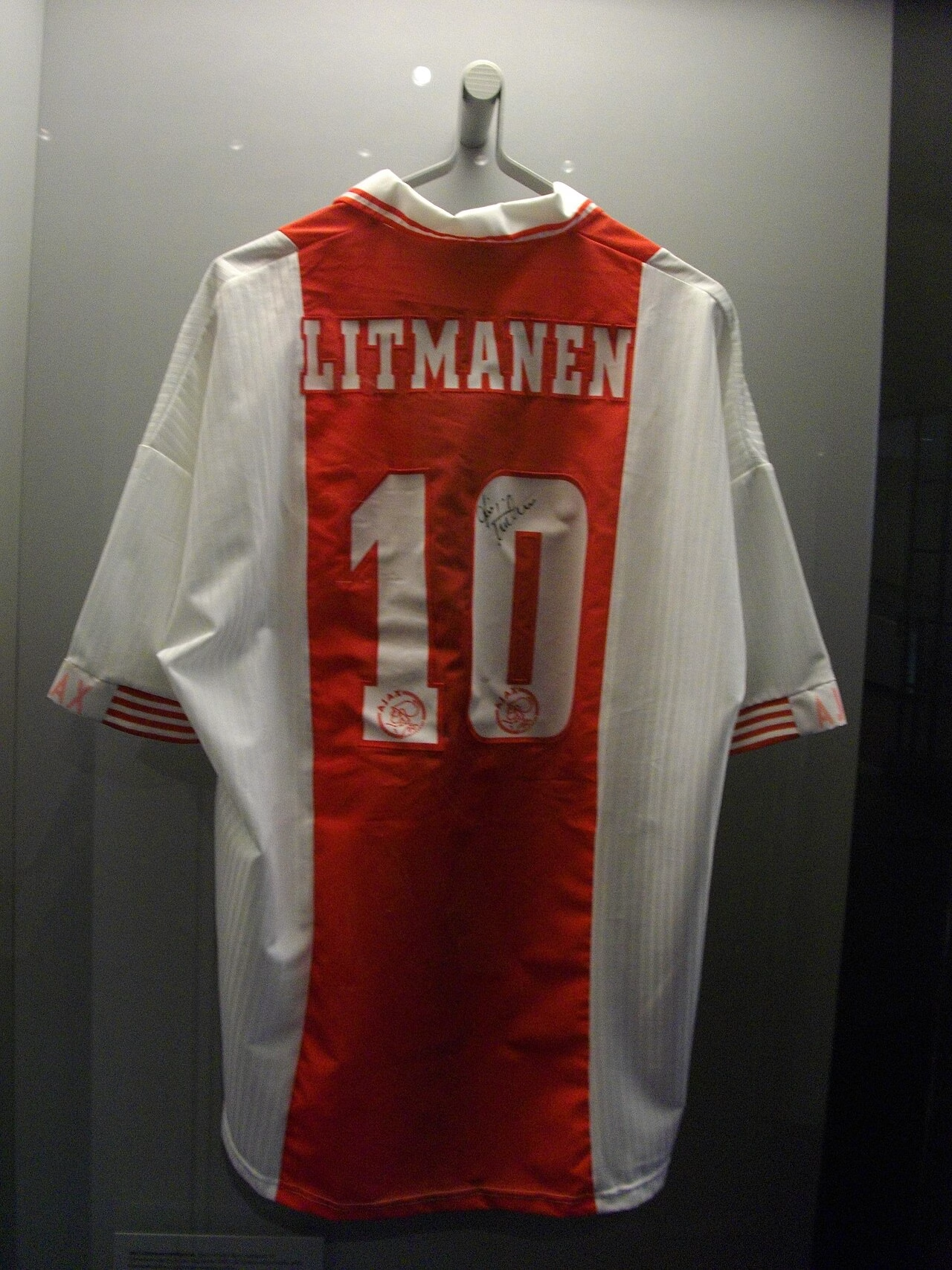
The quarry was not just a nice word. It was a structure. Van der Sar, Traveler, the De Boer, Seedorf, Davids, Kluivert: They were all part of that feeling of a club that did not buy an identity because it already had it.. That is the detail that makes Ajax so powerful today. 1995. It was not just a champion eleven. It was a promise: that a team could still look like home.
One, 24 May 1995: the shot that made Kluivert eternal
The final against Milan had something of a historical test. Milan came from dominating Europe with an almost imperial authority. Baresi, Maldini, Costacurta, Desailly, Donadoni, Boban: was not a rival, It was an institution. For a young team, Facing that Milan meant playing against names, memory and hierarchy.
The match was tense, cerrado, adult. It was not a video library rout or a fireworks display. It was a real final, one of those where each ball weighs a little more. Ajax had already beaten Milan in the group stage, but a final is another language. There it is not enough to play well. You have to keep your gaze when the game starts to run out of minutes.
And then Patrick Kluivert appeared. He came on from the bench and scored in the final stretch, with that short touch, almost instinct, that changed his life and the recent history of the club. I had 18 years. There are goals that are shots and there are goals that are doors. Kluivert's was an open door to retro eternity: a teenager pushing Ajax towards their fourth European Cup and leaving Milan without an answer.
UEFA remembers that final as the triumph of a young Ajax, with a very low average age, capable of denying Milan a second consecutive Champions League. But what remained on the retina was something else: the image of a team that seemed like the future, raising a cup that belonged to the club's most noble past.
Litmanen, the footballer who made everyone play
If Kluivert put the final frame, Jari Litmanen provided the background music during the season. There are players who shine because they accelerate. Litmanen shone because he ordered. I didn't need to raise my voice. appeared between the lines, turned, played, He arrived at the area and found that second advantage that separates the good ones from the special ones.
The Finn was one of the essential names of that Ajax. In an era dominated by highly visible forwards and postcard-perfect midfielders, Litmanen had a dry elegance, almost nordic. He didn't seem to act for the camera. He seemed to play so that the team could breathe. That's why his memory works so well in retro football.: was a star without noise, idol without excess, brain and dagger.
Davids, Seedorf, Kluivert: a generation that ran away too quickly
The greatness of Ajax 1995 It also has a sad point: It did not last long. The European market began to look at that squad like someone looking at a shop window.. Seedorf left for Italy. Davids would also end up in Serie A. Kluivert, Traveler, Bogarde, Overmars, The De Boer and Van der Sar followed great paths, but far from that original ecosystem.
That's where part of the nostalgia is born. We not only remember what was, but what could have continued to be. That Ajax seemed capable of opening a decade, but modern football dismantled it before the myth became custom. Maybe that's why we love him more.. Because there was no time to get tired. Because it was left intact, young, bright and a little impossible.
In Retro Football, That feeling connects very well with other stories from the years 90: the golden era of Ajax in the years 90, the African footballers who marked the League in the 90, or those cult players of the years 90 that still make us talk like they played yesterday.
El Ajax de 1995 and the old sentimental European Cup
The Champions of 1994-95 yes the Champions era, with hymn, groups and an increasingly recognizable aesthetic, but it still had some old European Cup. The Dutch champion could knock down the Italian champion without it sounding like a commercial miracle. A youth-based team could compete against a legendary defense. a boy from 18 years could decide a final without yet becoming a global brand the next day.
That balance between modernity and memory is what makes that Ajax so special. It does not belong entirely to ancient football or modern football. It's right on the bridge. Has tactics that anticipate the future, but a texture that no longer exists. has pressure, mechanisms and occupation of spaces, but also mud, young people with a neighborhood face and a club feeling that still seems organic.
Why that team continues to excite
El Ajax de 1995 It is still exciting because it was not only effective. It was recognizable. One can close one's eyes and see the red stripe, high pressure, open ends, Davids coming in like thunder, Litmanen floating, Van der Sar enormous, Blind raising the glass. That visual clarity is gold for memory.
It is also exciting because it talks about something that many fans miss.: the possibility of a project having time, roots and own language. Today there is a lot of talk about identity, but rarely do you see an identity as clear as that one. Ajax didn't seem to copy anyone. He seemed to remember who he was.
And maybe that's why, thirty years later, the team is still alive. Not as a statistic, but like a scene. One night in Vienna. A shot from Kluivert. A t-shirt by Litmanen. A generation that grew up too quickly and that, for a moment, made us believe that European football could still belong to the clubs that taught how to play rather than how to buy.
Frequently asked questions about Ajax 1995
What did Ajax win 1995?
Ajax won the Champions League 1994-95 when winning 1-0 against Milan in the Vienna final. He was also champion of the Eredivisie without losing a game, one of the reasons why that season retains so much aura.
Who scored the goal in the Champions League final? 1995?
Patrick Kluivert scored the decisive goal against Milan in the final stretch of the match. His shot made Ajax European champions and left one of the most memorable images of football over the years. 90.
Who was the coach of Ajax? 1995?
The coach was Louis van Gaal, key figure to understand the tactical structure, the commitment to the quarry and the competitive personality of that team.
Why is Ajax considered so special? 1995?
Because he joined the quarry, youth, tactic, personality and European success at a time when football was beginning to change. He was one of the last great champions of Europe with such a marked formative identity.
Sources and images used
For the historical and sporting context, the information sheet of the UEFA Champions League 1994-95 not UEFA, the memory of the final published by UEFA on Ajax-Milan 1995, the historical page of Ajax and seasonal data collected in AFC-Ajax.info.
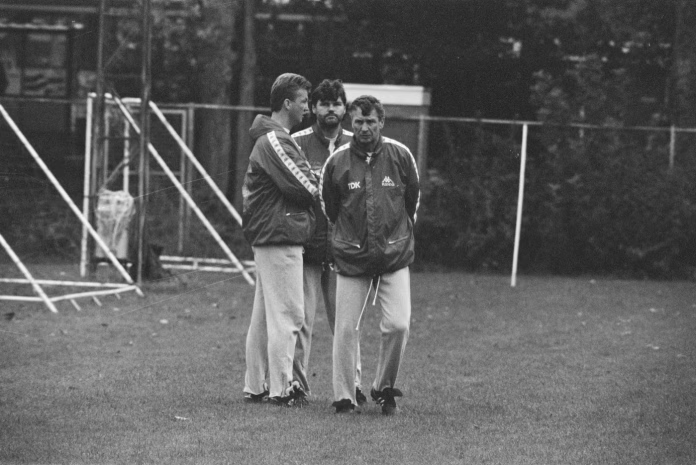
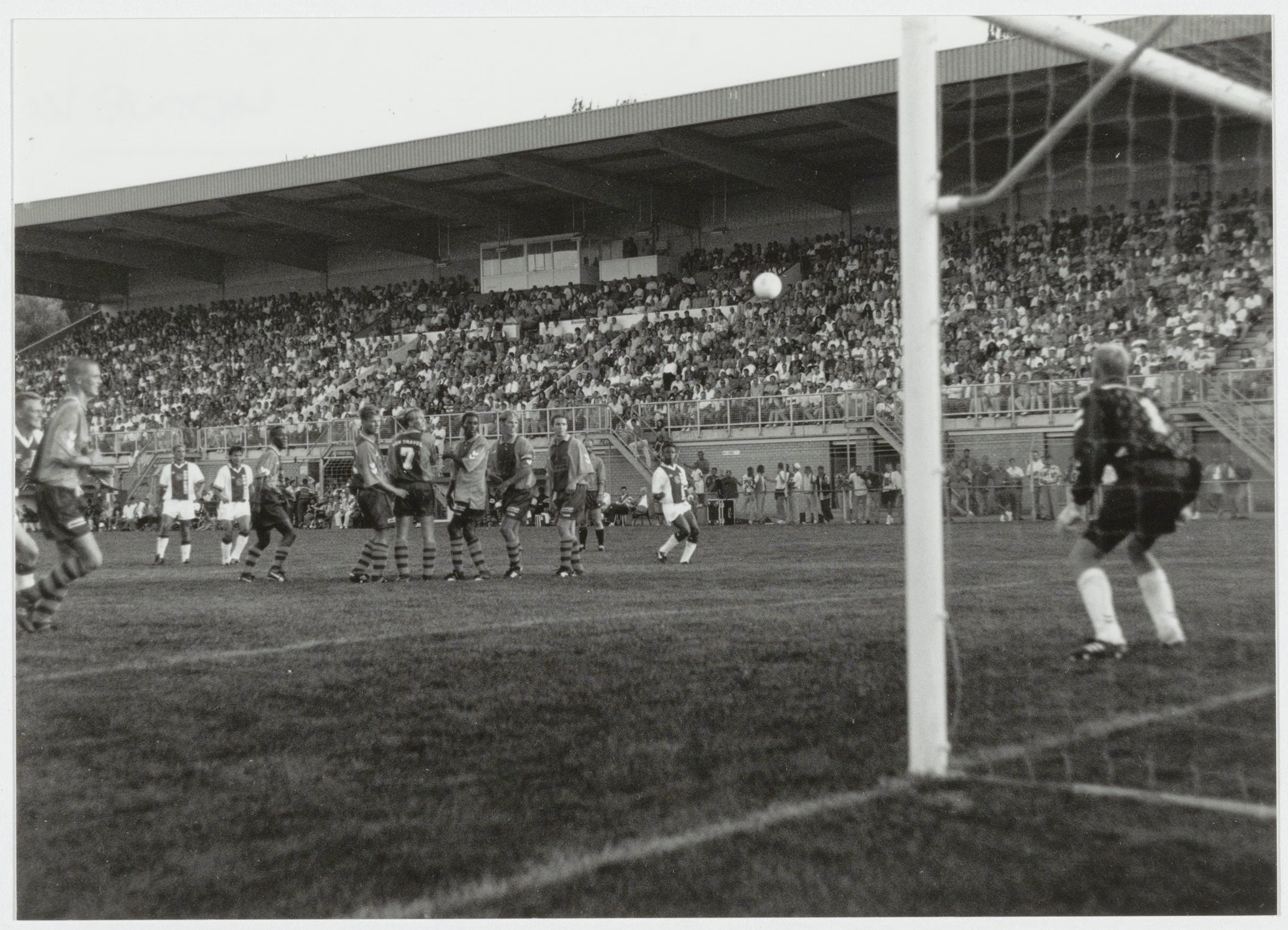
Reused images come from Wikimedia Commons: Ajax ante Haarlem and 1994, with CC0 license, Y Jari Litmanen t-shirt, published in public domain. No Getty photographs used, UEFA or official club file without free license.