Last update October 8, 2026 by Alberto Llopis
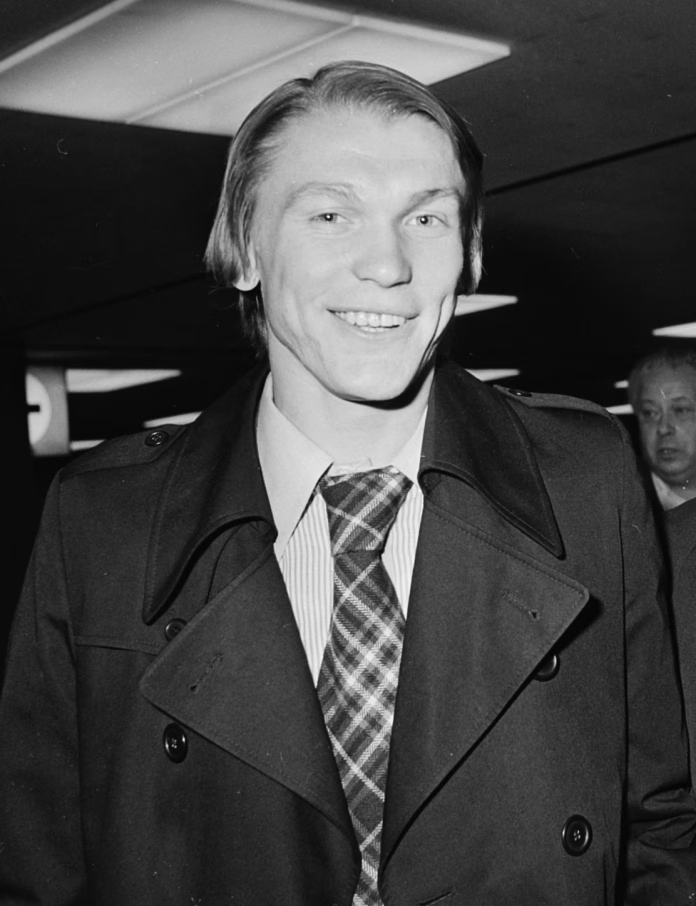
Oleg Blokhin won the Ballon d'Or 1975 with a shirt that was not that of Real Madrid, Barcelona or Bayern. He played for Dynamo kyiv, on the other side of a border that then also separated ways of understanding football. For many Western fans he appeared a few nights a year, in a European qualifier or with the letters CCCP on the chest. It was enough to see it start to remember its name.
In the images from that time the grass has a different color, The pants are shorter and the defenses grant spaces that today seem unthinkable. But its speed does not need restoration. Blokhin receives, advances the ball and forces the opponent to turn. That moment, when the defender realizes that he is already late, still explains it better than any medal collection.
A childhood between athletics and the ball
He was born in kyiv on 5 November 1952. his mother, Kateryna Adamenko, had been an outstanding athlete. At home they knew the demands of training long before Oleg became a name in the sports pages.
Blokhin himself said in an interview with AS that he practiced athletics and football until he was 16 years. He also remembered that at that age he ran the 100 meters in eleven seconds. It is convenient to tell the data as what it is: the memory of the footballer, not an approved brand that allows you to happily compare it with an Olympic sprinter.
He chose the ball. The track could measure how long it took to get to a place; football allowed him to decide what to do when he arrived. In that combination of acceleration and choice was a good part of their difference.
His left foot could resolve after a long career, but he also had pause to fool the goalkeeper. Reducing it to an athlete in boots leaves out the essentials: knew how to stand out, He interpreted the moment of the pass and maintained clarity when everything happened very quickly.
Lobanovski's Dynamo: the talent within the gear
To place Blokhin you have to join Valeri Lobanovski's Dinamo. That team made collective work, physical preparation and coordination of movements a competitive advantage. The brightest striker was also part of a plan.
The association is fascinating seen from today. A technician linked to analysis and discipline found in a dizzying attacker a way to turn ideas into occasions. Blokhin did not have to invent every move from scratch: His teammates knew where he could do damage and he knew when to speed up..
The Ukrainian club was then competing in the Soviet Union league. That precision matters: Calling all that football Russian erases identities and stories. The USSR national team and Soviet football brought together diverse realities, and Dynamo kyiv had a very powerful personality of its own.
In an interview published by the club decades later, Blokhin recalled that in 1974 They had top level players in almost all positions. Lobanovski and Oleg Bazilevich also worked with the national team. The weight of Dinamo was such that a good part of its automatisms traveled with the internationals.

1975: the Cup Winners' Cup that opened the door to Europe
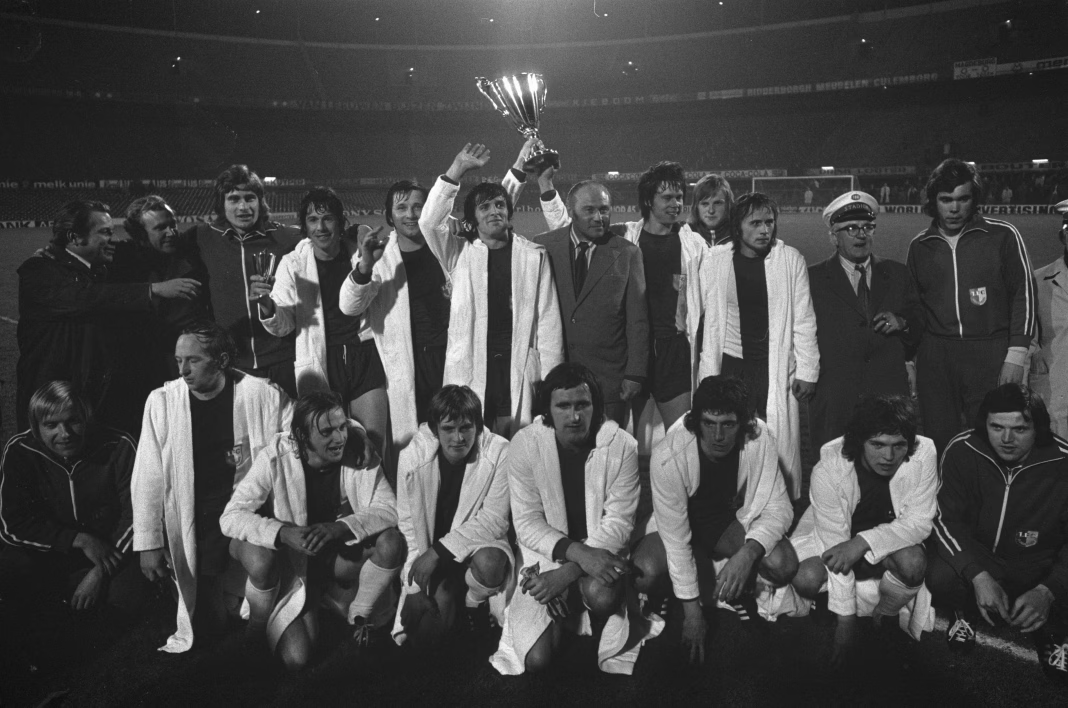
The 14 May 1975, Dinamo defeated Ferencváros by 3-0 in Basel. Vladimir Onishchenko scored two goals and Blokhin completed the result. The club won the Cup Winners' Cup and Soviet football debuted its record in the major UEFA club competitions.
To understand the scope of that triumph, we must remember the value that the Cup Winners Cup. It was not a minor prize for second-tier teams: brought together cup champions and offered nights of true continental hierarchy.
A year before he had won it Magdeburg that knocked down Milan in 1974. Now it was kyiv's turn. Europe also decided to stay away from the stadiums that monopolized Western covers.
Oleg Blokhin's career that left Bayern behind
The next test was Bayern, European champion. The Super Cup was played over two legs and the first leg was played in Munich on 9 September 1975. In front were names that already belonged to football history.
Blokhin scored the only goal with an action that still deserves to be sought out and seen in its entirety.. It started from the central zone, He crossed the defense and ended up beating Sepp Maier. The play preserves something that too short summaries often take away: the time it takes for a threat to become a certainty.
On lap, the 6 October, scored again twice. Dinamo won 2-0 and closed the tie with a 3-0 global. The three goals had his signature.
The great virtue of that series was that it did not need an exotic explanation. Bayern could put prestige on the field, experience and world champions. Blokhin scored three goals. Eastern football did not ask permission to sit at the table.
The Golden Ball of 1975, ahead of Beckenbauer and Cruyff
The France Football vote confirmed the size of its season: Blokhin added 122 points, Beckenbauer 42 and Cruyff 27. He did not win by a small margin or by a passing sympathy for a novelty. It was a resounding victory.
I had 23 years. He had helped Dinamo win the Soviet league, the Cup Winners' Cup and the Super Cup. His award brought individual recognition to a team that had forced it to look towards kyiv.
It is also worth remembering what that award measured then.: The Ballon d'Or was reserved for European footballers. It was a huge recognition., but their rules were not the current ones. Accurate telling does not reduce Blokhin; allows you to understand the world in which you played.
For the fan who browses the list of winners today, Your last name may seem like an interruption between more familiar names. For those who watched his matches 1975, the order makes perfect sense.
1986: was still there when another great generation arrived
Eleven years after that Cup Winners' Cup, Blokhin contested and won another. Dinamo beat Atlético de Madrid by 3-0 a Lyon el 2 May 1986. Zavarov opened the scoring, Blokhin scored the second and Yevtushenko closed the final.
Luis Aragonés' Atlético found themselves with an opponent capable of attacking with speed and precision from many positions. Igor Belanov and Aleksandr Zavarov represented another generation. Blokhin, already 33 years, was still part of the solution.
That detail corrects a too comfortable reading of his career. Footballers who only live off a start usually have problems when they lose a few tenths. He survived his own youth because he understood the game. Speed still mattered, but it no longer alone explained its presence.
The USSR t-shirt and the end of the journey
With the Soviet team he accumulated 112 parties and 42 goals, historical equipment records. He played in the World Cups in Spain 1982 and Mexico 1986, and won Olympic bronze in 1972 Y 1976.
At Dinamo he left seven Soviet leagues and five national cups. Their 211 goals in the league championship speak of a continuity that is sometimes hidden behind the race against Bayern. There was a long play behind the famous scene.
Going abroad has come to an end, with stages in the Austrian Vorwärts Steyr and the Cypriot Aris Limassol. It was not the usual journey of a contemporary star, that changes country as soon as its price reaches a certain level. His best football had been linked to kyiv for years.
Then he returned to the World Cup from the bench: led Ukraine to the Germany quarterfinals 2006, in the team's first participation in a World Cup final phase. The shirt had changed. His place in the history of that football was still there.
See him run again
Remembering Oleg Blokhin requires a small effort that is worth it: get out of the same ten surnames, tolerate the old image and let the play last longer than three seconds. Then an extraordinary striker appears, not a footnote to the Ballon d'Or.
There is nostalgia in those t-shirts, on the athletics tracks around the field and in the broadcasts that seemed to come from very far away. But nostalgia alone does not score three goals for Bayern. That was done by a footballer who combined legs, technique and intelligence.
In the recording, the defender turns again. Blokhin has already left.
Frequently asked questions about Oleg Blokhin
When did Oleg Blokhin win the Ballon d'Or??
In 1975, as a player for Dynamo kyiv. He surpassed Franz Beckenbauer and Johan Cruyff in the vote.
Was he Ukrainian or Russian??
He was born in kyiv and is Ukrainian. During his international career as a footballer he represented the Soviet Union, to which Ukraine then belonged.
What did he win with Dynamo kyiv??
Among its titles, the Cup Winners' Cups stand out. 1975 Y 1986, the Super Cup 1975, seven Soviet leagues and five USSR Cups.
Sources and photographs
Data contrasted with the Super Cup archive 1975 from UEFA, his chronicles of the Rewards from 1975 Y 1986, Dinamo's official records Y his interview with Blokhin about 1975. The memory of his times in athletics comes from the AS interview 2015; The voting for the Ballon d'Or is collected in the historical profile of AS.
Featured photography: Rob Croes / Anefo / National Archives; Materialscientist clipping. Portrait of Blokhin from 1977, CC0 1.0. The photo of Dynamo kyiv 1975 also comes from Anefo / National Archives bajo CC0. Each token allows you to verify the origin and rights.