Last updated June 29, 2026 by Antonio Sanchez
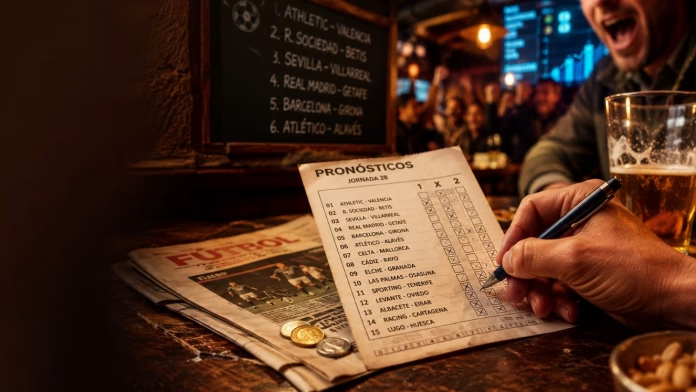
The sports predictions in Spain They started among friends in a bar in Santander. They wanted to have fun and started betting with each other., with the start of the country's first soccer tournament, which only had ten teams and was played in five games per day.
The idea grew among fans to such a level that people from other cities began to arrive to copy the formula.. Until the government saw that the bets were growing and took control of the business.
La Quiniela was officially born and thanks to technology it expanded between locations, offices and, during the last years, also with the mobile.
In 2011, Spain established a state framework to regulate online gambling, with licenses, age checks, authorized operators and safe gambling measures under the supervision of the General Directorate of Gambling Regulation.
That was another step in a story that began long before., when football was still followed from the bars, the radios and the results that came from the stadiums.
The Quiniela in Spain: from the Santander bar to online football
The first sports forecasts began almost a century ago, in 1929, in the city of Santander. The La Callealtera bar was the center of the first sports predictions.
It was common to arrive at the place and participate in the Soccer Stock Exchange or the Quintuple, because five games were played on each date. The idea was born from the bets that were made on cockfights in the backyard of the establishment..
A group of friends who arrived at the bar began to bet, guessing the results, that came from those who went to the stadium to see Racing de Santander or brought the information from somewhere. Sports betting added more followers until reaching a hundred at the end of La Liga.
The Football Stock Market expands throughout the country
The proceeds were put in a bag and the winner took them.. Everything was very well organized: a commission was created, A regulation was written and it was a total success.. The challenge was to find the results and the number of goals each team scored..
Everything gathered was distributed as prizes for the participants.. There was nothing left for the bar and the biggest prize reached eleven thousand pesetas at the time.. The impact was so great that people arrived from Madrid, Barcelona, Bilbao and San Sebastián to copy the formula. Others sent letters with their predictions from different towns..
The Quiniela owes its name to the fact that there were five games on each date and it moved so much money that it began to pay taxes to the Treasury.. Other bars in Santander also began to organize their own betting games.
The Football Stock Exchange ended after the Spanish Civil War, although it continued to be played as mutual sports bets for the benefit of the Santa Clotilde Sanatorium in Santander..
The Quiniela and the sports predictions of Spain
The goodbye to La Bolsa del Fútbol was nothing other than the official birth of La Quiniela, but now under state control. The 12 April 1946 The government decided to regulate sports betting in Spain and created the Charitable Sports Mutual Betting Board.
The institution started with eight boards spread across different cities in the country: Sevilla, Madrid, Barcelona, Bilbao, Corunna, San Sebastian, Valencia and Vigo. At the end of the first season there were already 26 workshops.
The board was born because fans were informally betting large amounts of money to guess the results of matches.. On the first official day they played 38.530 tickets and were raised 77.060 pesetas.
From the proceeds, a 45 percent was for the prizes, other 45 percent for charity and 10 remaining percent for administrative expenses. Was 62 prized tickets and only two hit the first category, with a prize of 9.603 pesetas for each one.
The final results were several days later because the entire process was manual. A form that evolved over the decades thanks to technology, when the results were more instantaneous and viewed on multiple screens within a single location.
Sports forecasts come to mobile
The advancement of technology meant that sports betting modalities were adding variants thanks to the Internet. Fans went from the computer to the mobile. Over the years, online pools appeared and the regulatory framework helped to organize an activity that had already moved to the digital world..
The regulation of online gambling in Spain
In 2011, The regulations were modified and Spain established a state framework to regulate online gambling. Various features were applied to recognize legal and safe spaces, such as identification of authorized operators, age controls and the role of the General Directorate of Gambling Regulation.
During years, the relationship between football, advertising and gaming operators were also part of the Spanish sports landscape, although in recent times this link has been subject to stricter regulations and new legal debates.
Currently there are several measures to maintain the order of the players, such as general deposit limits. In Spain, The system includes reference amounts of 600 euros daily, 1.500 euros weekly and 3.000 euros monthly, within a model designed to reinforce safe and responsible gaming.
There is also control of operators authorized by the General Directorate of Gambling Regulation. Regulated sites are required to verify the identity of users, who must be older than 18 years and not appear in the General Registry of Gambling Access Bans.
A) Yes, The history of sports predictions in Spain went from a bag full of pesetas in a bar in Santander to a regulated system, digital and connected to modern football. But the origin still has something very retro football: friends meeting in a bar, results that arrived late and a passion for guessing what could happen the next day.