Last updated June 6, 2026 by Alberto Llopis
Scotland in the World Cups It has one of those stories that seem written for retro football: massive illusion, unforgettable t-shirts, players with character, dramatic matches and a border that was never crossed. The Scottish team has competed in eight World Cup finals, but he has never managed to overcome the first phase. It's not just a statistic; It is a sports injury that is repeated generation after generation.
Argentina remains in popular memory, above all. 1978, for Archie Gemmill's goal against the Netherlands and for the previous collapse against Peru and Iran. But the curse came from before and continued after. Scotland competed, won matches, He had names of enormous prestige and on several occasions he was one detail away from advancing. The story, but nevertheless, always found a way to close the door.
Scotland in the World Cups: a selection condemned to almost
The first great peculiarity of Scotland in the World Cups, central keyword of this world cup story, is that we are not talking about a minor selection. During much of the 20th century, Scottish football had tradition, pride and a very powerful identity. Their clubs competed strongly in Europe and their players were regulars in the English league.. The problem was not the absence of talent, but the difficulty of turning it into a long World Cup campaign.
Scotland debuted in the World Cup 1954 and came back in 1958, 1974, 1978, 1982, 1986, 1990 Y 1998. Eight appearances, eight eliminations in the group stage. In some cases it was a clear elimination; in others, a question of goal difference, calendar, pressure or poor reading of key moments. That repetition made the Scottish case a rarity: a historically respected team that never managed to enter among the best in a World Cup.
On the FIFA website and in the historical record of the Scotland national football team the contrast is clear: a lot of world presence, but no jump to the decisive rounds. For a country where football is part of popular culture, That border outweighs many isolated bad results..
1974: undefeated, but removed
If there is an edition that summarizes the Scottish torment before Argentina 78, It's Germany 1974. Scotland was drawn with Brazil, Yugoslavia y Zaire. Zaire won, tied with Brazil and tied with Yugoslavia. finished undefeated. And still went home on goal difference.
The data is cruel because Scotland did not lose a single match. In a group of enormous equality, The lack of a larger victory against Zaire was decisive. That tournament also left one of the most remembered scenes of the World Cups., Mwepu Ilunga's famous action in a Brazil foul, an episode that we already reviewed in the play's surreal World Cup history.
The removal of 1974 installed a dangerous idea: Scotland could compete against anyone, but I needed to learn to manage the details. In a World Cup, tying with giants is not always enough. Sometimes you also have to know how to close the group with authority against the apparently weaker rival..
Argentina 1978: from the national dream to the coup against Peru
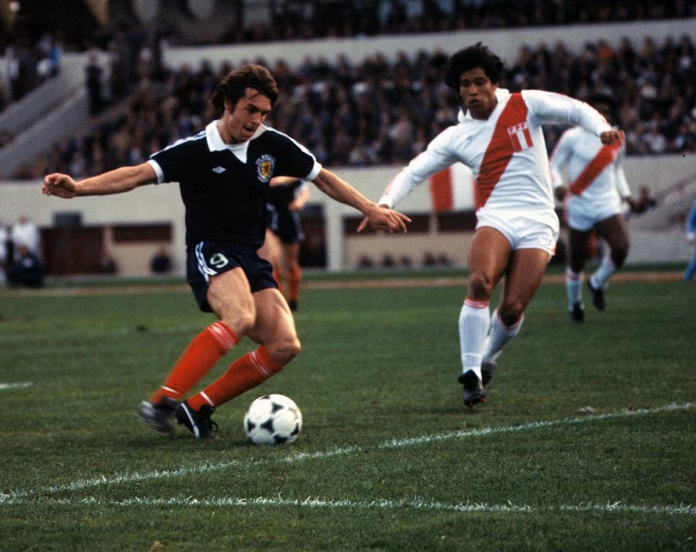
Argentina 1978 It was the World Cup that turned Scottish history into a bitter legend. The selection arrived with very high expectations, to the point that part of the country saw her as a candidate to do something enormous. The team had figures, character and an atmosphere of euphoria around. but football, like so many times, did not forgive overconfidence.
The first game was a very tough defeat against Peru. Teófilo Cubillas scored a memorable direct free kick and Scotland received a blow that affected the entire tournament. Then came the draw against Iran, another devastating result for their aspirations. to survive, The Scots needed a very comprehensive victory against the Netherlands, finalist of the previous World Cup and one of the strongest teams of the time.
That match left Scotland's most famous moment in the World Cup: Archie Gemmill's goal. A wonderful drive, rivals surpassed, fine touch and eternal celebration. Scotland won 3-2, but it was not enough for him to pass. The goal was left for the videos, elimination for history. In a way, the country had signed a precious victory and an emotional defeat in the same afternoon.
Spain 82 and Mexico 86: compete against giants
In Spain 1982, Scotland once again had a demanding group. He beat New Zealand with authority, lost to Brazil and tied against the Soviet Union. The problem was again the goal difference. Brazil was Socrates' team, Zico, Falcão and company, one of the most admired ever, how we count in Brazil 1982: the most beautiful defeat in football history. Scotland fought, but the group left no room.
Mexico 1986 It was even rougher.. Scotland shared a group with Denmark, Federal Germany and Uruguay. Denmark was experiencing its brightest explosion, a generation that we have already remembered in Denmark 1986: the Danish dynamite that made the world fall in love. Scotland lost to Danes and Germans, and tied against Uruguay in a match conditioned by the very early expulsion of José Batista.
That 0-0 against Uruguay it was another frustrating chapter. With a rival with ten from the first minute, Scotland could not find the way to the goal. The team needed to win and couldn't. The feeling was known: Each World Cup offered a different opportunity, but they all ended with the same farewell.
Italy 90: the last great occasion of the old cycle
Italy 1990 It was a tournament of closed defenses, short markers and constant tension. For Scotland, It was also another missed opportunity. The initial defeat against Costa Rica was decisive. Then they beat Sweden and lost to Brazil. Again, classification narrowly escaped.
The defeat against Costa Rica hurt because it seemed like the game that the group should organize. Brazil was Brazil, even in a less brilliant version than that of 1982, and Sweden was competitive. But losing in the debut against the rival that many considered more affordable left Scotland forced to row too early.
Italy 90 It also has a strong nostalgic charge for retro fans, from the ball and television nights to video games like World Cup Italia 90 for Sega Mega Drive. For Scotland, instead, It was another postcard of World Cup frustration.
France 98: the return and farewell
Scotland's last World Cup until today was France 1998. It was not a generation as mythologized as that of the seventies, but the team returned to the big stage and had the honor of opening the tournament against Brazil. lost 2-1, They tied with Norway and fell clearly against Morocco. Again, group stage. Again, back home.
Since then, Scotland has not returned to a World Cup. He has had proud nights in Euro Cups and qualifying phases, but the World Cup absence has lengthened the shadow of that old curse. In each failed attempt the same thing is remembered: Scotland is not only looking to qualify, finally seeks to break a historical barrier.
Why the Scottish curse continues to fascinate
Scotland's history in the World Cup fascinates because it combines epic and repetition. It is not the case of a selection without tradition that appears once and disappears. It is a country with a football identity, huge rivalries like the Glasgow derby between Celtic and Rangers, historical stadiums, traveling fan and a very intense emotional relationship with her shirt.
It is also fascinating because many eliminations had a specific scene: the goal difference of 1974, the blow against Peru in 1978, the insufficient draw against the USSR in 1982, the blockade against Uruguay in 1986, the fall against Costa Rica in 1990. There is no single disaster, but a collection of moments that make up a legend.
Because, when talking about great incomplete stories of international football, Scotland deserves a place. He didn't win a World Cup, did not play a final, It didn't even pass a first phase. But he left goals, t-shirts, songs, character players and a question that still awaits an answer: When will Scotland finally cross that line??
Maybe that's the strength of Scotland in the World Cups: the curse is not sustained only by defeats. It is not sustained only by defeats, but for the repeated hope. Each generation believes it can be the one to break the pattern.. And as long as that possibility remains alive, Scotland in the World Cup will continue to be one of the most human stories of retro football.