Last updated June 11, 2026 by Alberto Llopis
Mexico 1986 It wasn't just Maradona's World Cup. It was a tournament with such a recognizable personality that it can still be summarized today in a few images.: the midday sun over the Azteca Stadium, the blue shirt of Argentina, the Mexican wave running through the stands, the Azteca ball rolling on dry fields and a television that began to turn each play into a global memory. Few championships have been so linked to an aesthetic, to a climate and a way of telling football.
The World Cup in Mexico 1986 arrived after an unexpected change of headquarters. Colombia had initially been designated, but he gave up organizing the tournament due to financial and logistical problems.. Mexico took over and became the first country to organize two World Cups, after having also hosted the edition of World 1970. That continuity gave the championship a special air: the same country that had seen Pelé's Brazil crowned was now welcoming a different generation, with another rhythm, another television and a figure destined to occupy the center of history.
A World Cup with its own identity
Mexico 1986 had an immediate identity. The huge stadiums, the altitude, The heat and the schedules adapted to European television conditioned the game and also the memory of the tournament. Many matches were played under very harsh light, with teams forced to measure efforts and games that could change suddenly when the legs began to weigh. That mix of monumental scenery and physical exhaustion gave the championship a very particular tone..
The format also helped build the story. The group stage gave way to direct knockouts from the round of 16, which multiplied the tense intersections and left less room for speculation. From there, every important match became a small movie: favorites who suffered, revelation selections, extensions, penalties and nights in which a single detail could change the history of a country.
The Azteca Stadium as an emotional center
If there is a place that sums up Mexico 1986, that is the Azteca Stadium. Decisive matches were played there and the most powerful image of the tournament was recorded there.. The stadium was already legendary for the final of 1970, but in 1986 added another layer to his legend. Its size, Its acoustics and its way of wrapping the matches made it more than just a venue.: It was the stage where the World Cup seemed to get bigger.
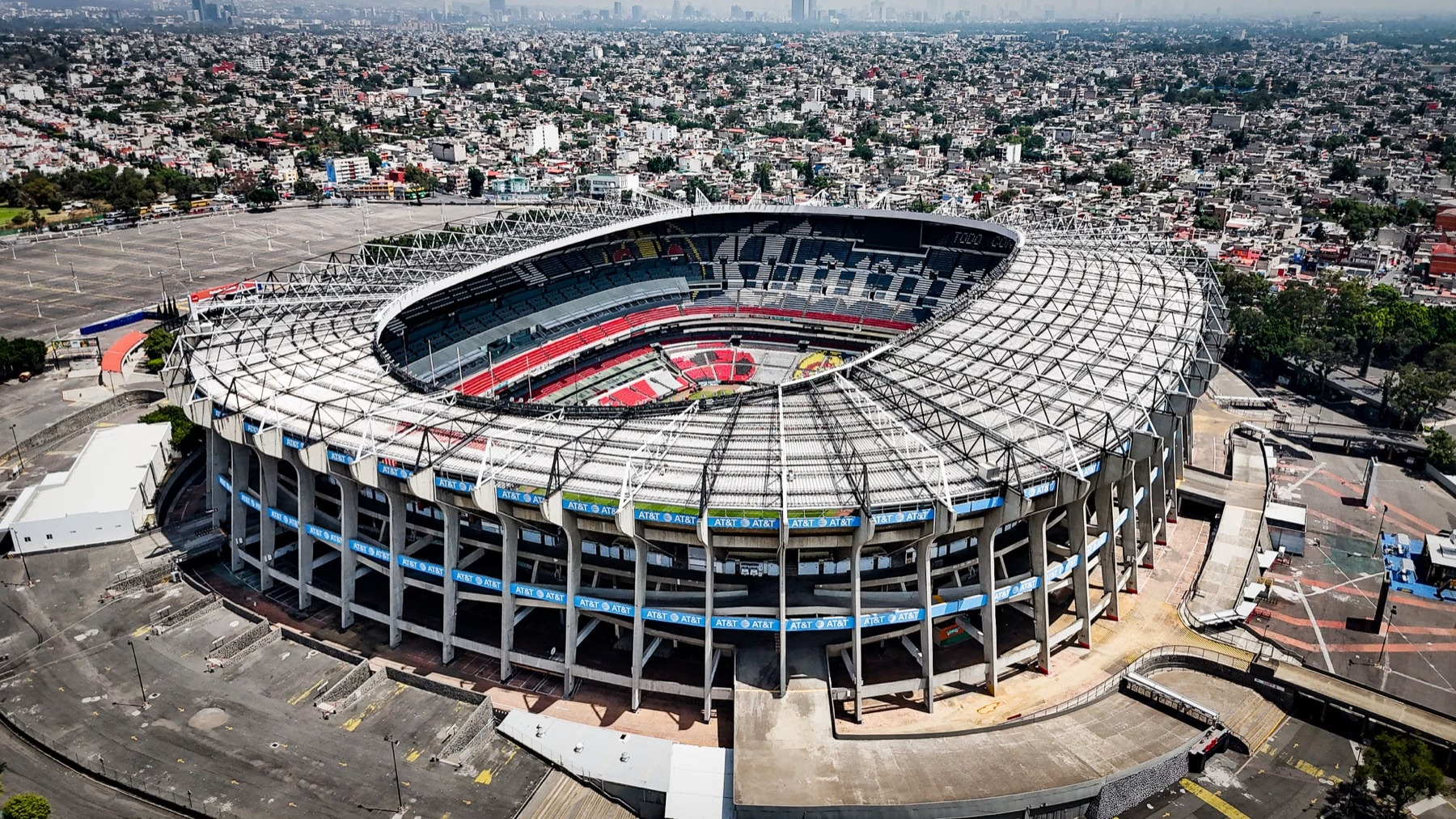
The Azteca also represents an ancient way of remembering football. It was not a perfect or neutral stadium. He had an almost physical presence in the broadcasts: endless stands, cement, noise, partial shade and that feeling that any important play was amplified by the place. In Mexico 1986, the stadium was not a set. It was part of the story.
Maradona and the weight of an entire Cup
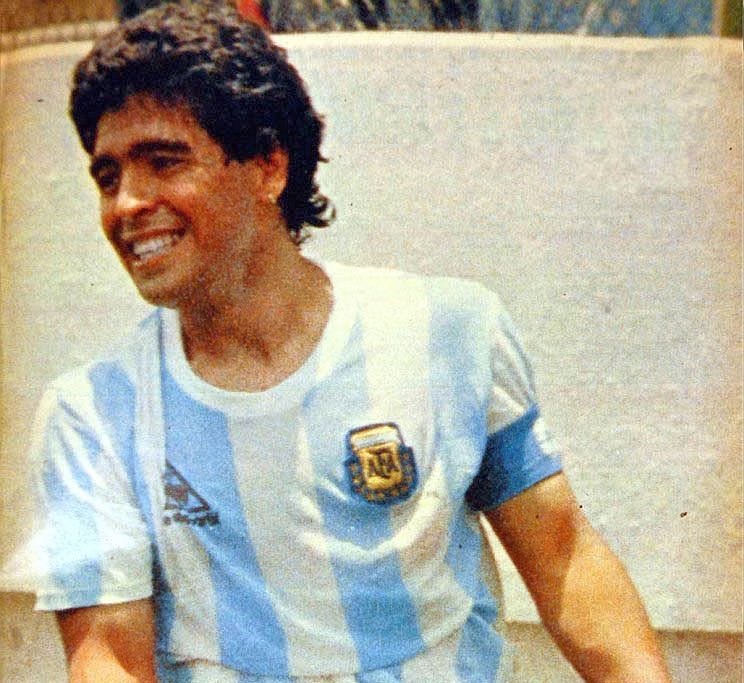
Diego Armando Maradona arrived in Mexico with 25 years and emerged as an unrepeatable historical figure. His World Cup cannot be explained only by two goals against England, although those two goals are inevitable. It is explained by the feeling of dominance that he transmitted throughout the championship.. Argentina played with order, character and a structure designed to sustain it, but every game seemed to have a moment when Maradona found a passing line, a dribble or acceleration that no one else saw.
Against England, in quarterfinals, Mexico 1986 found his definitive image. The Hand of God and the Goal of the Century condensed contradiction, genius, controversy and beauty in just a few minutes. That match not only decided a tie: forever fixed the place of the tournament in the memory of football. To read the complete tour of that performance, you can follow the special Maradona in 1986 match by match.
Argentina, a more collective champion than it seems
The force of the myth has meant that the World Cup has often been reduced to Maradona., but Argentina was more than a great player. Carlos Bilardo built a competitive team, uncomfortable and mentally prepared to live in pressure. Nery Pumpido, Ruggeri, Brown, Batista, Giusti, Burruchaga and Valdano were part of a structure that protected its star and gave meaning to each stage of the tournament.
The final against West Germany showed that collective dimension. Argentina moved forward 2-0, Germany matched its usual ability to survive and, when the game seemed to go wrong, Maradona filtered the pass that Burruchaga converted into the 3-2 definitive. It was a final with tension, classic reaction and outcome. It did not have the aesthetic cleanliness of other champions, but a huge competitive force. A good part of his greatness lies in that balance between talent and resistance..
The other names of the tournament
Mexico 1986 He also had a collection of memorable supporting roles.. France arrived with Michel Platini, That's it, Giresse and company, an elegant generation that had just won the European Championship 1984 and that still retained enormous quality. Brazil presented a team with important names, although far from the collective magic of 1982. West Germany once again showed that it could compete even without falling in love. Belgium signed a historic championship, reaching the semifinals with Enzo Scifo as one of the names of the tournament.
Spain experienced a World Cup of mixed emotions. The defeat of Denmark, with four goals Emilio Butragueno, It was one of the most remembered nights of Spanish football in the eighties. But the elimination against Belgium on penalties left a bitter feeling, of lost opportunity. Mexico 1986 had precisely that: moments of euphoria that could turn into disappointment in a matter of days.
The aesthetics of Mexico 1986
An important part of the nostalgia of this World Cup comes from its objects. The Adidas Azteca ball, with its design inspired by pre-Hispanic motifs, It is one of the most recognizable in history. The shirts still had a very physical presence: shiny fabrics, marked collars, large shields and silhouettes that today we immediately identify as eighties football. Everything seemed less uniform than in modern football, and that is why each selection left an image that is easier to remember.
It was also a World Cup of stickers, television summaries and press covers. For many fans, Mexico 1986 It is not remembered only for the complete games, but by fragments: a repeated narrative, a cropped photo, a t-shirt seen years later, a recorded summary or an image that comes back every time retro World Cups are talked about. That's why it's still so powerful.: does not belong only to the file, belongs to the sentimental memory of football.
Why Mexico 1986 it's still different
The championship preserves something that not all World Cups have: a very clear central story and, at the same time, many secondary roads. There is Maradona, Clear, but there is also the Aztec, the mexican wave, the emotional revenge against England, the final against Germany, the talent of France, the belgian surprise, the spanish drama, the ball, the shirts and the feeling of football still close to mud and myth.
Looked at from a distance, Mexico 1986 works as a border. It still has a lot of old football, with players less shielded by the global image and games with obvious physical toughness. But it already belongs to the modern television era, with goals repeated over and over again until they become symbols. That mix explains why he's still alive.: looks old, but it's never completely gone.
Mexico 1986 still has something difficult to manufacture: a complete image. It does not need to be explained from the outside to seem important. Just go back to your games, to its goals and its scenarios to understand why so many fans recognize it as one of the World Cups with the most personality of all time.